
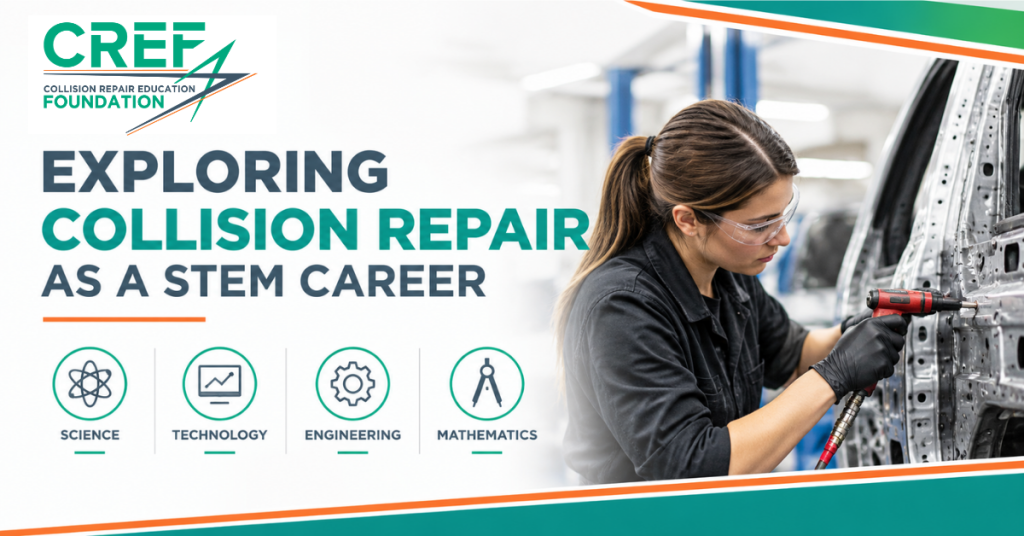
Ask most high school students what they picture when they think of a STEM career, and you’ll probably hear familiar answers like programming, laboratory research or electrical engineering.
But what about the technology built into the vehicles they see and ride in every day?
Today’s vehicles are incredibly sophisticated, filled with advanced materials, electronics, cameras, sensors and computer-controlled systems. When one of those vehicles is involved in a collision, repairing it takes much more than knowing how to fix what you can see.
Collision repair professionals need to understand how a vehicle is built, how its systems work together and what it takes to restore it properly. That can mean applying physics to understand how collision forces travelled through a vehicle, using computer diagnostics to identify issues with electronic systems, working with the chemistry behind modern repair and refinishing materials, and relying on precise measurements and engineering principles throughout the repair.
That’s where collision repair and STEM naturally come together.
It’s a career that combines technical knowledge with hands-on skill and problem-solving, and as vehicle technology continues to advance, the knowledge and skills required to repair them continue to grow right along with it.
What Makes Collision Repair a STEM Career?
Take a step back and look at a modern vehicle. It’s a combination of science, technology, engineering and mathematics working together in one incredibly complex machine.
The structure is engineered to manage collision forces and help protect the people inside.
Different metals, aluminum, plastics and composite materials are used throughout the vehicle for specific reasons. Computers communicate with cameras, radar and sensors to support safety and driver-assistance features, while mechanical, electrical and electronic systems all work together to keep the vehicle operating as designed.
Even the shape, weight, materials and placement of components have been carefully engineered with performance, efficiency and safety in mind.
When that vehicle is involved in a collision, all those elements become part of the repair.
Repairing a modern vehicle means working with the science, technology and engineering that were built into it in the first place, while using mathematics, technical information and hands-on skills to help put it back together properly.
That’s what makes collision repair such an interesting STEM career. The technology isn’t separate from the work. It’s built into the vehicle and, as a result, into the repair itself.
How STEM Is Used in Collision Repair
So what does all of that look like once a damaged vehicle enters a collision repair facility?
Damage isn’t always limited to what you can see. The force of a collision can travel through a vehicle, affecting its structure, components and systems beyond the immediate area of impact. Understanding what happened and what needs to be repaired can involve physics, vehicle construction, material properties and careful measurement.
From there, different collision repair professionals bring their own expertise to the process, with each person looking at the vehicle through a slightly different lens.
A repair planner may research OEM repair procedures, review the vehicle’s construction and identify the operations, parts and procedures required to develop a complete repair plan. That can mean working with estimating software, technical information, measurements and vehicle-specific repair requirements before the physical repair even begins.
Structural technicians then take that information and apply it to the vehicle itself, focusing on repairs involving its structure. They may measure and analyze structural damage, work with specialized repair and welding equipment, and understand how materials such as high-strength steel and aluminum need to be handled. Precision matters because different materials and vehicle structures can require very different repair methods.
Non-structural technicians bring another set of skills to the repair process, focusing on damaged body panels and other non-structural components. Their work may involve repairing dents, replacing panels, checking alignment and preparing surfaces for refinishing. While the repairs may be different from structural work, they still require careful measurement, an understanding of materials and the ability to determine the appropriate repair techniques.
Depending on the size of the facility, collision repair technicians may work in both areas or specialize in one.
Diagnostic technicians focus on another layer of the vehicle. Using scan tools and diagnostic technology, they can identify issues within electronic systems, investigate diagnostic trouble codes and help determine which systems may require additional procedures, programming or calibration as part of the repair.
Then there’s refinishing, where science and craftsmanship come together in a completely different way. Refinish professionals work with chemistry, mixing ratios, color theory and application techniques, while using technology such as spectrophotometers and digital color tools to help achieve an accurate color match and high-quality finish.
No single skill tells the whole story, and no single role completes the repair on its own. Each person contributes a different area of technical knowledge, and together, those skills help take a damaged vehicle through the repair process and safely back to the road.
How Technology Is Changing Collision Repair Careers
The technology inside vehicles isn’t standing still, and neither are the careers of the people who repair them.
Advanced driver assistance systems, commonly known as ADAS, are one example. Cameras, radar and sensors support features such as automatic emergency braking, adaptive cruise control and forward collision warning. Following a collision, these systems may need to be scanned, diagnosed, initialized or calibrated as part of the repair.
Electric vehicles are creating new areas of specialization as well. High-voltage systems bring different procedures, safety considerations and training requirements for the professionals working on them.
Vehicle construction continues to evolve too. Manufacturers are using different combinations of high-strength steels, aluminum, composites and other advanced materials, each with its own repair considerations and requirements.
All of that creates an industry where learning doesn’t stop once someone finishes school or enters the workforce.
For someone who loves figuring out how things work, that can be one of the most exciting parts of the career. There is always another vehicle, system or technology to understand, and new opportunities continue to develop as the automotive industry moves forward.
The Science and Technology Behind Automotive Refinishing
Not every part of STEM looks like a computer screen or diagnostic tool.
Step into the refinishing side of collision repair and you’ll find another interesting combination of science, technology and craftsmanship.
Matching a vehicle’s color takes more than finding a paint code. Refinish professionals need to understand how color behaves, how different materials interact and how factors such as mixing ratios, application techniques and environmental conditions can affect the final result.
Technology plays a role here too. Tools such as spectrophotometers can help analyze color and identify formulations, but there is still skill and experience involved in creating a finish that blends naturally with the rest of the vehicle.
And then there’s the artistic side.
Color theory, blending, shaping, symmetry and attention to detail all become part of the work. It’s one of the reasons collision repair can also fit naturally into the idea of STEAM, where art joins science, technology, engineering and mathematics.
There aren’t many careers where chemistry, technology, craftsmanship and an eye for color can all be part of the same job.
Career Paths in the Collision Repair Industry
One of the great things about entering collision repair is that choosing the industry doesn’t mean choosing one job for the rest of your career.
Someone may begin as a collision repair technician or refinisher and discover an interest in diagnostics. Another person may find they have a talent for estimating and repair planning. Others may eventually move into management, training, technical support, manufacturing, product development or other areas of the automotive industry.
As vehicles continue to change, new specialties and opportunities are emerging too.
That gives students the chance to find the part of the industry that fits their own interests and strengths. Someone who loves technology may be drawn to diagnostics or ADAS. Someone who enjoys working with their hands may find their place in structural repair. Someone with an eye for detail and color may be interested in refinishing.
And those interests can change over time.
The first job someone takes in collision repair doesn’t have to define their entire career. It can be the beginning of a path that continues to grow as they gain experience, develop new skills and discover different parts of the industry.
How Students Can Explore a Collision Repair Career
Of course, students can’t consider a career they don’t know much about.
That’s why giving young people opportunities to see and experience the collision repair industry matters.
CREF is finding creative ways to make those introductions. Its free Build-A-Car Simulator lets students virtually build and customize a vehicle, giving them a fun first touchpoint with an industry they may not have considered before.
From there, students can take that curiosity further by exploring collision repair programs, visiting schools, attending career events, meeting industry professionals and gaining hands-on experience that helps them understand what the work is actually like.
For students who decide collision repair is the direction they want to pursue, there are several ways to begin building a career, including technical education, apprenticeships, on-the-job learning and specialized training.
CREF works to support those connections between students, schools and the collision repair industry, helping more young people discover the opportunities available to them and take their first steps toward a career.
A STEM Career With Real-World Impact
At the end of the day, all of the technology, science, and technical knowledge involved in collision repair serves a very real purpose.
A damaged vehicle came into the facility. Someone trusted the people working on it to repair it properly. And when that vehicle returns to the road, the team behind the repair can see the result of the knowledge, skill and care they put into their work.
For students who enjoy technology, like solving problems, want to work with their hands and are excited by the idea of continuing to learn, collision repair offers a STEM career where those interests can become practical skills with a meaningful purpose.
And there has never been a more interesting time to consider where those skills could lead.
Vehicles will continue to evolve. New technology will continue to enter the repair process. New specialties will emerge, and the people entering the industry today will have an opportunity to grow right alongside it.
The future of collision repair will be shaped by people who understand that technology, embrace continuous learning and take pride in highly skilled work that matters.
For the next generation, collision repair offers the opportunity to become part of an industry that is constantly moving forward while continuing to play an essential role in keeping people safe on the road.